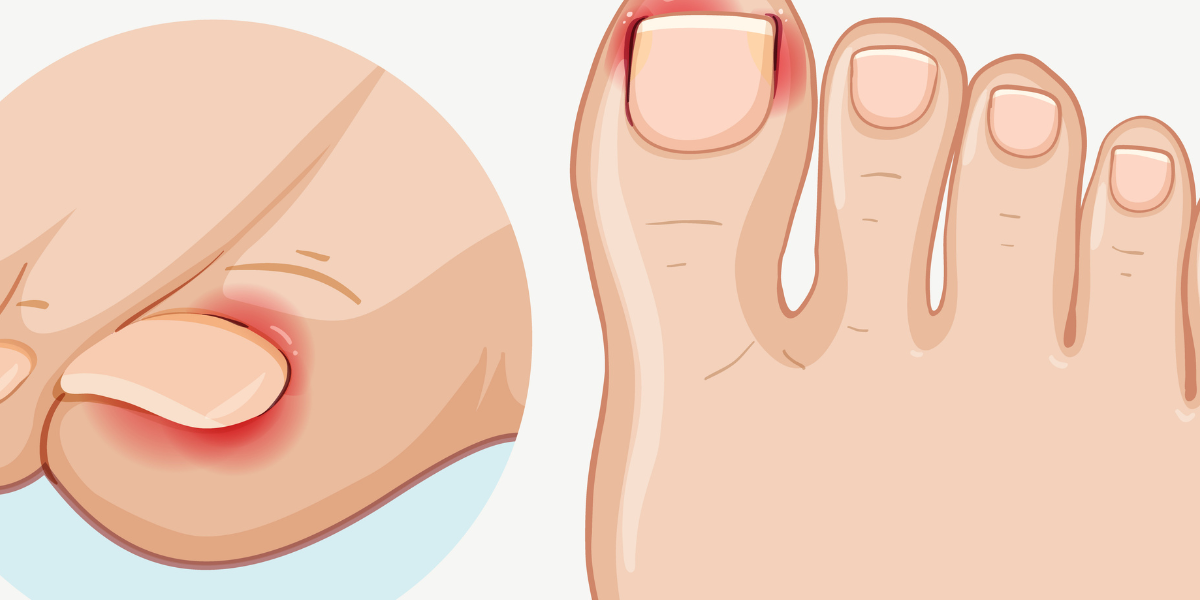
Ingrown toenails are far more common than most people realise. Research shows that around 2.5 to 5 percent of the general population deals with an ingrown toenail at any given time, and it accounts for roughly 20 percent of all foot related complaints seen by doctors
For something that affects so many people, it is surprising how often it gets brushed off until the pain becomes hard to ignore. The tricky part is that an ingrown toenail rarely starts out as an emergency.
It often begins as a small irritation, the kind of thing you might assume will sort itself out. Sometimes it does. Other times, it quietly gets worse until walking, wearing shoes, or even resting your foot becomes uncomfortable. Knowing what to look out for, and when it is time to stop waiting it out, can save you a lot of unnecessary discomfort.
An ingrown toenail happens when the edge of the nail grows into the skin beside it instead of over it. The big toe is almost always the one affected, and it usually starts on one side of the nail rather than across the whole width.
In the early stages, the skin next to the nail might look a little red and feel tender when you press on it. You might notice it more when wearing tight shoes, since the pressure tends to make the area feel worse. At this point, it can be easy to mistake it for a minor irritation that will pass on its own.
As it progresses, the redness can spread, the area may swell, and the skin can feel warm to the touch. Some people notice fluid building up under the skin near the nail, or even a small amount of discharge if the area becomes infected.
Persistent pain that does not ease after a few days of basic care, such as soaking the foot and wearing roomier shoes, is one of the clearer signals. If anything, pain that gets worse over time rather than settling down is a sign the nail is continuing to dig into the skin.
Visible pus, yellowish discharge, or a strong odour coming from the area usually points to an infection that has set in. At this stage, home remedies are unlikely to resolve things on their own, and the longer it sits, the more uncomfortable and difficult to treat it tends to become.
Spreading redness beyond the toe itself, especially if it starts moving up toward the foot, is another sign worth taking seriously. This can indicate the infection is no longer staying localised, which makes it more important to get it looked at sooner rather than later.
It is easy to underestimate how much a small toe problem can affect daily life. Many people try to manage things themselves for weeks, hoping the discomfort will fade, especially if they are busy or simply do not want to make a fuss over what feels like a minor issue.
The trouble is that ingrown toenails tend to follow a fairly predictable pattern. Without proper ingrown toenail treatment, the nail keeps growing in the same direction, and the surrounding skin keeps reacting to it. What started as mild redness can turn into a cycle of swelling, pain, and recurring infection that becomes harder to fully resolve the longer it continues.
Persistent pain, swelling that fails to decrease or any signs of infection are worth having looked at, rather than left as a self-directed problem. A specialist will examine the nail, determine its extent of growth and suggest a treatment plan tailored to the condition of toenail.
At Fabulous Foot Care, one of the approaches used for ingrown toenail treatment is the Onyfix system. It is non-surgical, no pain, a gentle technique which changes the direction the nail grows in, without anaesthetic or surgery. The nail is coated with a special composite material which hardens and provides bracing for the nail, and over time, the nail slowly re-aligns to a healthy growth pattern.
If your toe has been bothering you for more than a few days, or if you have noticed any of the warning signs mentioned above, it is worth having it looked at sooner rather than later. Catching things early generally means a simpler, more comfortable path to recovery.
Fabulous Foot Care offers assessments and ingrown toenail treatment using the Onyfix system, both in clinic and through mobile foot care visits for those who prefer care at home. If you have been putting off dealing with a sore toe, booking a quick assessment is a simple way to find out exactly what is going on and what your options look like.
If pain persists beyond a few days, gets worse, or you notice swelling, discharge, or spreading redness, it is a good sign that home care alone will not be enough and it is time to have it assessed.
No. The Onyfix system is applied without cutting or anaesthesia, and most people find the process comfortable from start to finish.
They will be able to, especially when habits such as wearing tight shoes or cutting nails too short are maintained. After care instruction post treatment minimises that risk of recurrence.
Our new clinic is now open inside Revital Physio & Massage Legacy.
Same trusted foot care from Mayur — now closer to you in south Calgary.